Nile Celebration Mosaic, 5th-6th century CE
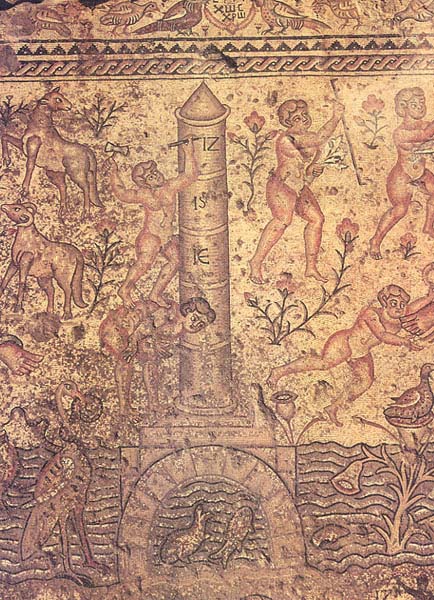
Nile Celebration Mosaic
The Nile flows through the center of the floor, pouring out of the mouth of an animal near the top of the scene. A smaller stream winds its way down through the hunting scenes at the bottom of the mosaic. The Nile is richly decorated with its natural flora and fauna. Along its banks are a fisherman with his fishing net, a stork with a snake as prey in its mouth and a bird perched on a lotus flower. A fish swims down the river.
Above the Nile is a Nilometer set on a rectangular structure with an arched opening facing the river. The Nilometer measured the height of the water. This determined the tax rate for that year. The higher the water, the higher the tax. As the fifth-century B.C.E. Greek historian Herodotus said, “Egypt is the gift of the Nile.” When the Nile flows heavily and floods, the crops grown on the fields along the river are abundant. When it doesn’t, there may be a famine.
Nilometers were built at many sites along the river, usually beside temples. One Nilometer has actually been found near Alexandria, but mostly we know them from pictures. In practice, the Nilometers were set in square or round pits dug out beside the river. In depictions, however, the artist wanted to emphasize the height of the water, which would not be possible if the Nilometer were placed in a pit. Thus, the Nilometer was customarily portrayed as a round, towerlike pillar on which signs and numbers appeared.
The Nilometer on the Sepphoris mosaic is marked with horizontal lines with the numbers 16, 15, and 17—15, 16 and 17—between the lines. These numbers refer to the height of the water in cubits. Beside the Nilometer, a man holding a hammer and chisel stands on a woman’s back in order to get sufficient height to engrave the number IZ (17).
Depictions of Nilometers have been found at two other sites in Palestine—the house of Leontis in Beth-Shean and the Church of the Multiplication of the Loaves and Fishes at Tabgha on the shore of the Sea of Galilee.2 At Beth-Shean, the numbers on the Nilometer are 10, 11, 12, 13, 14, 15, 16; at Tabgha they are 6, 7, 8, 9 and 10. We have not yet been able to explain the difference.
Other Nilometers are known from mosaics elsewhere. They have even been found on coins, textiles and other small objects. Usually, however, any people near the Nilometer do not relate to it. The Sepphoris mosaic is rare in that the man is actually engraving the number on the Nilometer. So far as we have been able to tell, the only other example of a person engraving a number on a Nilometer is on a silver bowl in the Hermitage Museum in St. Petersburg (formerly Leningrad).
Ehud Netzer and Zeev Weiss, “New Mosaic Art from Sepphoris,” BAR 18-06, Nov-Dec 1992.
Subscribe
If you enjoyed this article, subscribe to receive more just like it.


