House of Eusebius, 4th-7th century CE
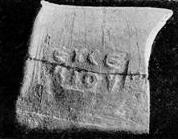
From the Byzantine period, we uncovered a structure that had previously been exposed by Macalister and Duncan. We uncovered a small part of it, however, for the first time. A single room that had survived the centuries had a plain, white mosaic floor belonging to a multi-roomed house that Macalister and Duncan called the House of Eusebius, a name imprinted on one of the drain tiles in the house. The House of Eusebius no doubt belonged to someone of considerable wealth. The house was built in typical Byzantine style, with a central peristyle courtyard just like the Byzantine houses discovered in Benjamin Mazar’s excavations at the foot of the Temple Mount.
The House of Eusebius was built directly on top of remains from a large building from the Second Temple period (late first century B.C.E. and first century C.E.). It was apparently built as a residence, but all that survived was part of the basement whose floor contained a number of water installations. Particularly impressive were a large (17 by 10 feet) plastered pool, a plastered room covered by an arch and a plastered ritual bath (miqveh) with steps. Within the arched room was an assemblage of pottery testifying to the date of its last use—70 C.E., the year in which the Romans destroyed Jerusalem.
Excerpted from Eilat Mazar, “Did I Find King David’s Palace?” BAR, January/February 2006.
What do you want to know?
Ask our AI widget and get answers from this website